

Getting cooler...definitely maybe...

Hello, friends. Hope you are all well and not too heat-frazzled. I guess it’s a bit of a bore now to mention the heat, and we should all be nonchalant/blasé about it. Today (Saturday) we’re down to 25C which is positively cool in comparison to recent days and I’m thankful. But I’m also looking forward to it BEING OVER and I would love it to rain. There is a hosepipe ban in the next few parishes to us and I’m sure it will get to us if it doesn’t rain a fair bit soon. As school holidays begin and the county is deluged with visitors then water consumption goes through the roof. I am really coming round to the idea of there being a tourist tax to cover these things, but I know the hospitality industry would squeal like mad.
The garden is bone dry and hard as granite, lots of plants are really suffering. I’m watering pots and the roses that are still sporadically flowering but nothing else. There will be losses. There have already been losses—of the spring planted perennials two oriental poppies, two geum have gone, one tiarella gone, two lupins with terrible mildew, two of the new roses looking very sick indeed with brown leaves and mostly bare stems (and I’ve been watering them), and most things in flower are looking dry and faded. The canna seem to be doing okay and we have some lilies that are okay too but goodness things are feeling the heat and dry. Agapanthus are also suffering, but not from the heat, from the dreaded agapanthus mite, a horrid little fly that lays its eggs in the flower buds so that they either are horribly distorted or don’t flower at all. Worst of all there is, as yet, no known treatment. I am having to cut off all the buds and flowers in the hope that the miniscule blighters can’t pupate in the soil and do it all again next year. It may not work and if anyone has successfully rid their agapanthus of these horrors I would be pleased to hear how you did it. Meanwhile here are one or two things I spotted doing well whilst out and about this week:
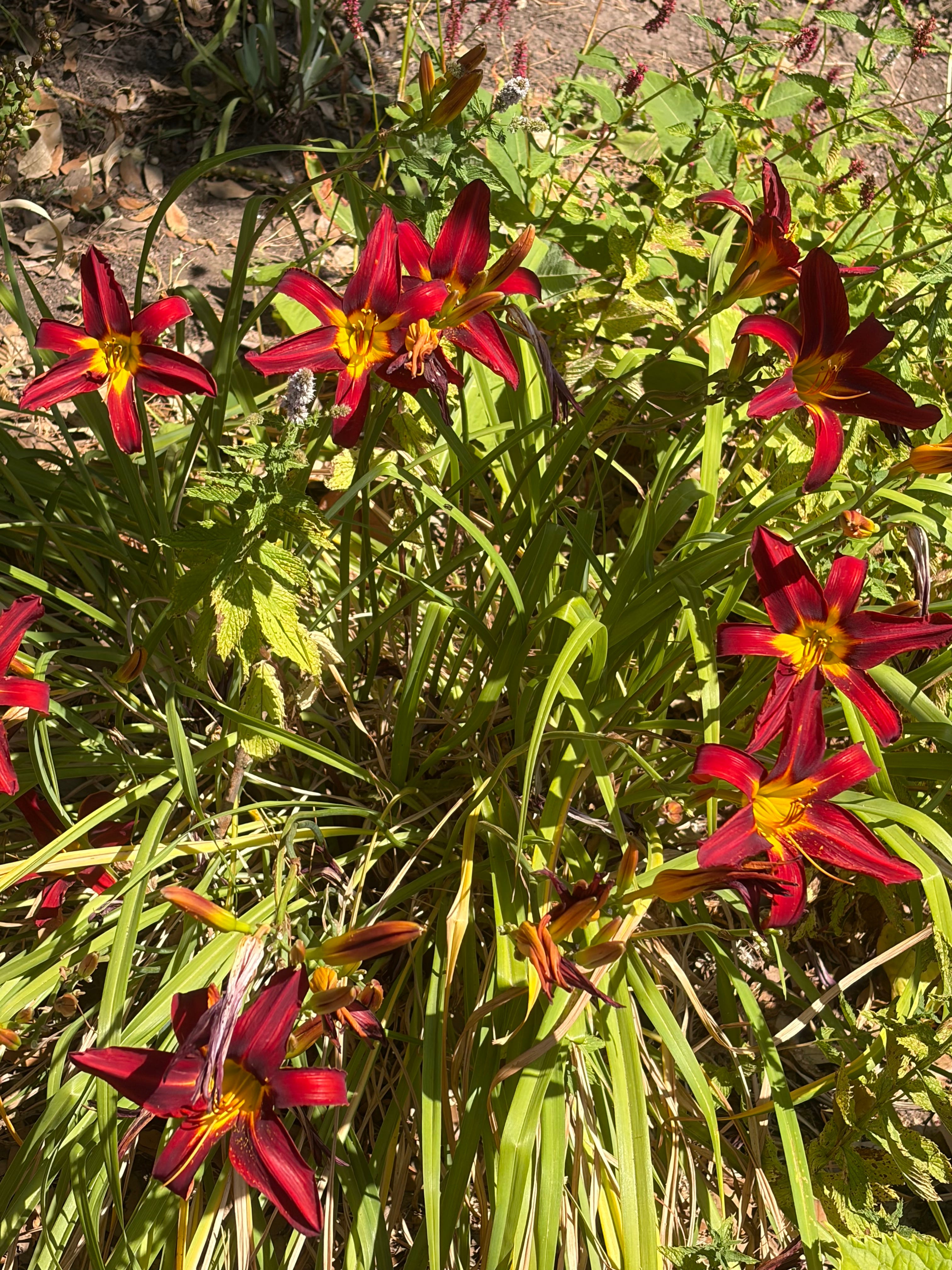
These crimson day-lilies in the town gardens:
And this is what I call a hydrangea! Also in the town gardens:


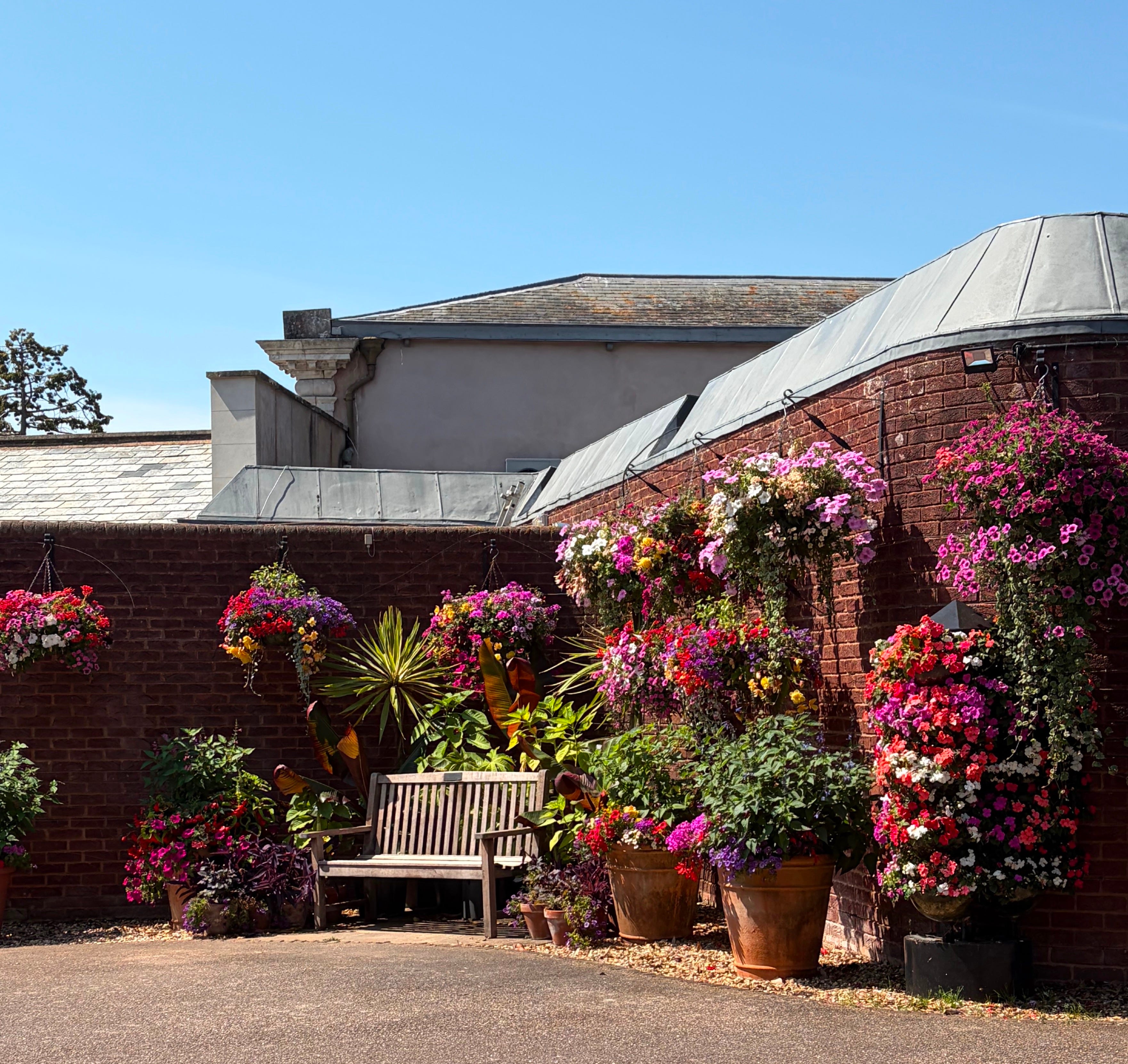
This magnificent display of pots at the entrance to Bicton Gardens:
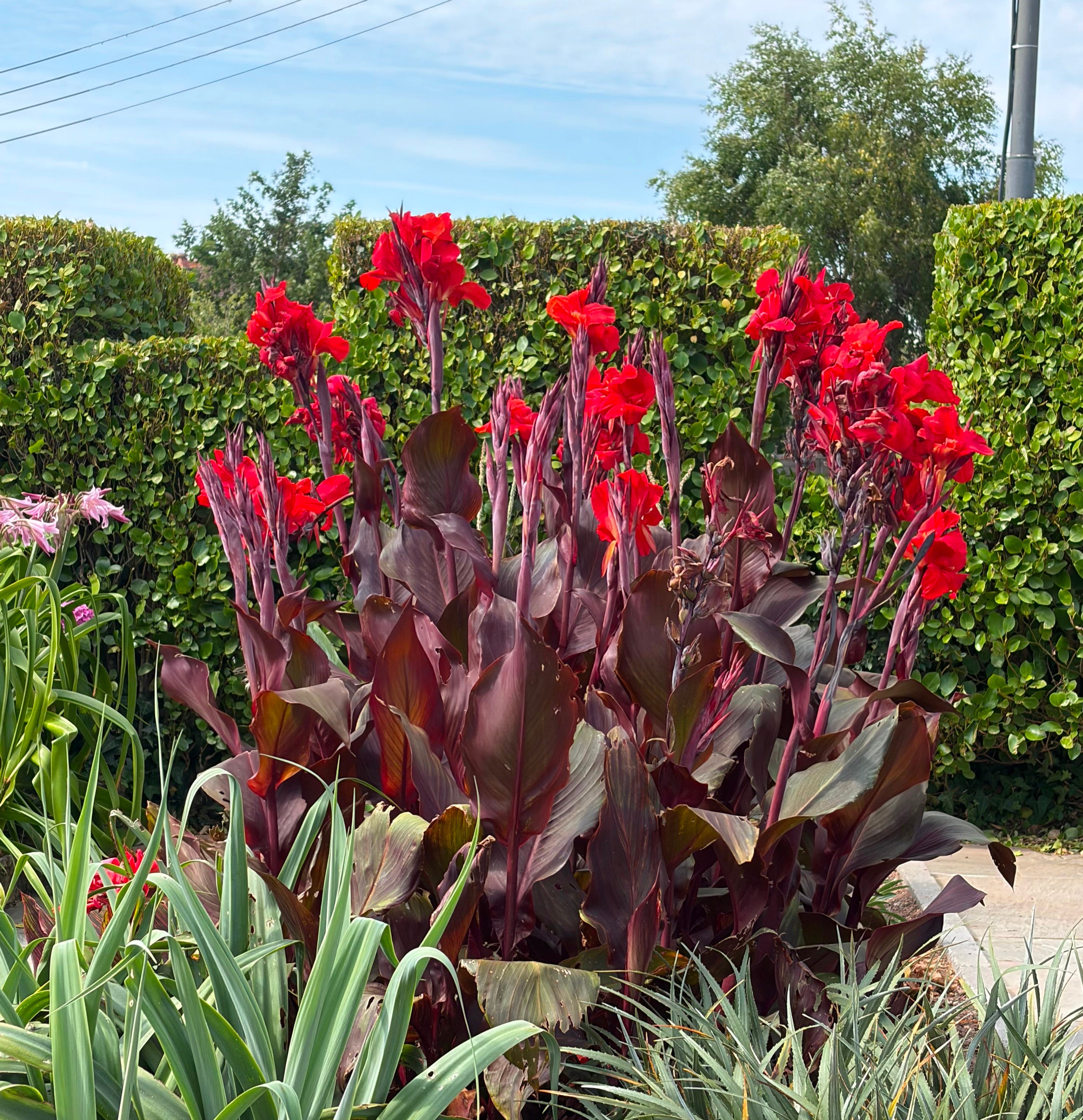
And the canna in my own front garden:
So, some things are thriving and there is plenty of loveliness to be found. Especially in the butterfly world which seems to be loving the hot, dry weather. Nonetheless, butterfly numbers are not good and this weekend is the start of The Big Butterfly Count for 2026. It’s easy to take part - you just sit in an outdoor space and count any butterflies you see in 15 minutes. It can be the garden, a park, the beach, anywhere. All the details are on the website in the link, together with help to identify, and there is also a very useful App you can download for counting while you’re out and about. Do participate if you can.

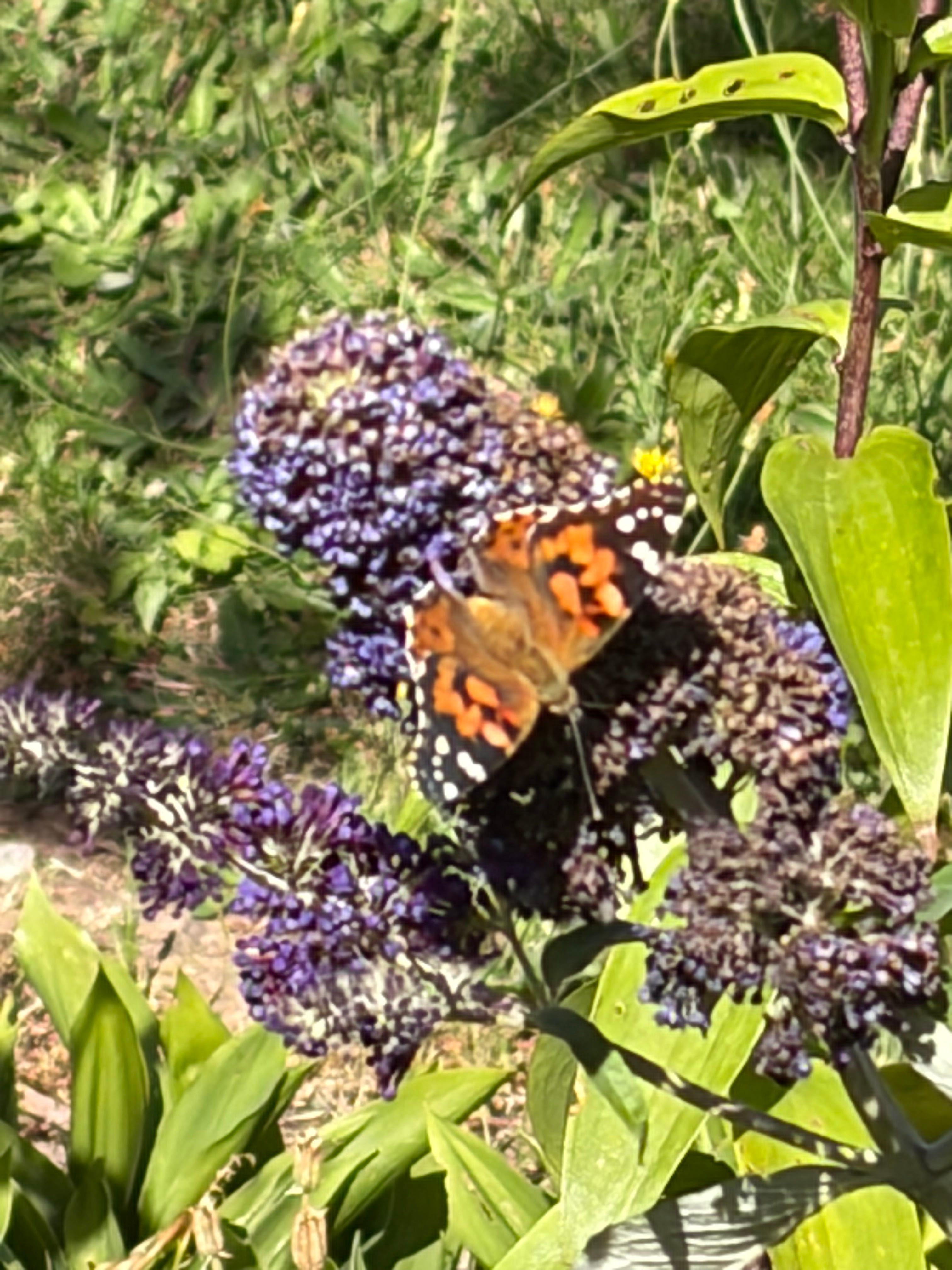
Generally, butterflies will be enjoying the heat, but lack of rain because of drought is a real problem. Caterpillars hatching in the next few weeks will need fresh green food plants and if the plants have dried up and died because of the heat, the caterpillars will starve and the numbers of the next generation of butterflies, later this year or in 2027, will be reduced. This happened after the 1976 drought when butterfly numbers crashed the following year. It took until 1984 for the most common of our butterflies to recover—those we are most likely to see in our parks and gardens—and butterflies that require species specific food plants have never really recovered. So, do go to the Butterfly Conservation website and see how you can help a butterfly. Here’s a Painted Lady from my own garden.
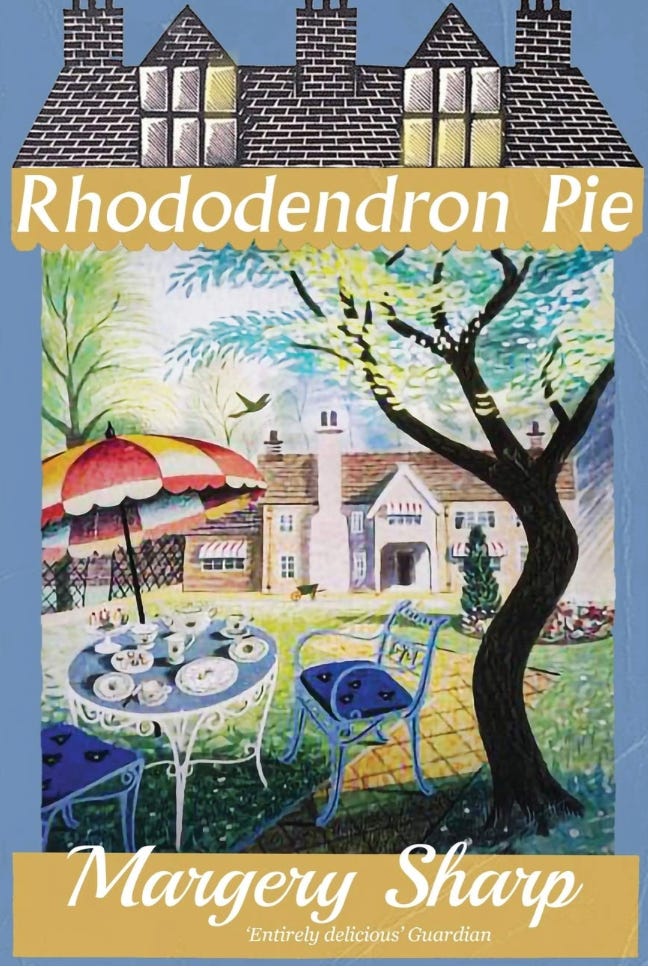
This week’s completed fiction reading has been Rhododendron Pie by Margery Sharp, her first novel, published in 1930. Apparently rattled off in a month whilst living in a bedsit in Paddington with two friends. I’m new to Ms Sharp, and it was a pleasure to discover her sharp eye and gentle humour.
The story centres on Ann, the youngest member of the rather unusual Laventie family of anti-social Sussex gentry. The Laventies live in a world of beauty, ideas and artistic sensibility, where being ordinary is considered almost a moral failing. Their house is full of charm and eccentricity, and ‘Modern’ ideology, and Ann has grown up believing that this is the ideal way to live. But as she gets older, she begins to question whether a life devoted entirely to appearances and originality is quite as satisfying as it first seems. She has always been something of an outlier from her intellectual, artistic and literary family; enjoying spending time with the neighbouring children, doing jigsaws and generally looking for simpler pastimes. As the Laventies grow up and gravitate to the artistic and literary life in London, their differences become more obvious, and Ann has to battle between wanting to fit in with her dazzling siblings and wanting a rather more settled, ‘ordinary’ life.
The title is clever. When young, the Laventie children were given a pie crust filled with flowers on their birthday—her sister Elizabeth had heliotrope, brother Dick cowslip, and Ann the titular rhododendron. Rhododendron pie may sound exotic and beautiful, but it is not something anyone would actually want to tuck into. Anne always hoped for apple pie. It’s a perfect symbol for the difference between things that look impressive and things that genuinely nourish us. Sharp is exploring the all-too-human tendency to be attracted to what is unusual or glamorous or clever, while quietly asking whether it is really what makes us happy.
Sharp’s characters are carefully drawn and although the Laventies are ridiculous at times (most of the time), and the source of much exasperation, she never mocks them with cruelty. They are charming and funny and popular, and I could understand why Ann is drawn to their world even while she is beginning to understand its limitations. There is romance and there are misunderstandings, but I think this is really a coming-of-age story about deciding what kind of life you want to lead and having the courage to step outside of the box prepared for you by family upbringing. Ann’s journey is not a dramatic rebellion; rather, she gradually learns to separate the values she hasinherited from her upbringing from the things that actually matter to her.
Although the novel is nearly a hundred years old, the themes feel surprisingly modern. The questions about image versus substance, family expectations and the pressure to live up to other people’s ideas of what makes a successful life are all very recognisable. There is no fast-paced plot here, but Sharp’s wit, her affection for her characters and her understanding of human nature make it an enjoyable read. Like many of the best novels about ordinary life, it turns out that beneath the surface of a quiet story there is rather a lot going on. It has similarities with Angela Thirkell’s Barsetshire novels but, in my opinion, lacks her brightness and lightness of touch.
I will certainly read more of Sharp and definitely recommend this charming and thoughtful novel, particularly to anyone who enjoys gentle satire, family ups and downs, and the pleasure of discovering a slightly forgotten classic. It’s published by Dean Street Press under their imprint Furrowed Middlebrow which is dedicated to publishing women writers of the early and mid-twentieth century. I’d never heard of them but will be seeking out more from their list.
I’ve also just finished Anne Hall’s Angela Thirkell: A Writer’s Life (2021). I had this for Christmas and it has finally reached the top of the non-fiction TBR pile and has been much anticipated. I understand that it is generally regarded as the best modern introduction to Thirkell’s life, though not necessarily the last word on her. I found it a bit like the curate’s egg.
Hall presents Thirkell as a far more complex and sympathetic figure than earlier biographers have done. She gives a detailed account of her remarkable family background—granddaughter of artist Edward Burne-Jones, goddaughter of J. M. Barrie, cousin of Rudyard Kipling and Stanley Baldwin—alongside a rather less detailed account of her turbulent personal life, two unhappy marriages, years in Australia, and eventual success as the creator of the Barsetshire novels. There are an awful lot of peripheral characters and I sometimes found it difficult to see where we were in Thirkell’s life, and why some of these people were influential or important to her. There are hints that she was not particularly liked—by her brother, her cousin Rudyard, her eldest sons and more—but there is no discussion or follow through on this.
The biography makes extensive use of letters and archival sources, which mean we do hear Thirkell’s own voice emerge through the pages. There is meticulous archival research and documentation, and there are numerous illustrations and photographs. It does offer a balanced reassessment of a writer who has been previously quite harshly treated by some commentators, although, to be honest, I found it a bit flat—a kind of fact parade interspersed with quotes from letters and family papers.
Given Thirkell’s eventful life, the book is relatively short (about 160 pages) and I did think that Hall didn’t probe too deeply into Thirkell’s psychology, her relationships with her sons (and other members of her family), or the creative development of her books. I wanted rather more information on her Barsetshire novel development particularly and was disappointed not to find it. I haven’t read other biographies—Margot Strickland’s biography of 1977 is probably best known—but from reviews I gather that Hall’s work is considered to be more carefully researched and more fair. It’s also creditable that Hall refuses to sensationalise Thirkell’s private life, although I think we could have been given more information without it being prurient. As it is, I was left with questions unanswered and certain events were hinted at rather than explored.
For anyone new to Angela Thirkell, Hall’s biography is a good place to start finding out about her. It’s concise, authoritative, and sympathetic. I learned plenty I didn’t know about her, although she still feels somewhat enigmatic. Scholars or more devoted Thirkell enthusiasts, however, may still hope for a fuller, more interpretive biography that explores in greater depth the relationship between Thirkell’s eventful life and the enduring appeal of her fiction.
Now, who has been watching I, Jack Wright serialised on BBC (also on Iplayer)? I binged it during the week when it was too hot to go outside and loved it! It’s a rollicking good murder story with a great cast and lots of twists and turns. And if, like me, you’re not so keen on Trevor Eve, don’t worry ‘cause he gets bumped off in the first five minutes and then his madly horrible extended family really come in to their own. Give hit a go.
And that’s enough for this week. If you enjoyed this do hit the little heart. Or you could treat me to a cup of tea! Anyhow, take care and I’ll write soon. x
June, I hadn’t realised it was the Big Butterfly Count. We’ve had several visiting our garden lately. Just yesterday, while I was making my mid-morning coffee, a red admiral landed on the nearby window. Well, I say she was a red admiral. Looking at your photo, I’m wondering if she was actually a painted lady. Either way, she sat there quite contentedly, letting me appreciate her lovely colours and patterns through the clear glass.
I enjoy your writing, June - its gentle warmth and the fact that I always learn something