

Soaked and surprised.
Where I am defeated by the weather and enthralled by Ronald Blythe.

Hello from a very wet east Devon. There were floods in the early part of the week, the ground is saturated, and still it rains. There is (yet) another yellow warning for rain in two days time. It’s also still very windy and very cold. So not much getting out and about, sadly. A couple of trips into town and a chilly walk along the Esplanade (not at high tide) was about it. The sea is rough and boiling even at low tide, and at high tide the waves overtop the Esplanade showering shingle onto the road. Our regular coffee shop–which is right on the sea front–has had water in under the door in spite of sandbags twice this week. Three villages around us were flooded with roads closed for a while, and our own little river Sid became the roaring twice-as-big river Sid, brown and racing, covering the wier and the footpath and the meadow it runs through as it approaches the sea front. Hopefully it will calm down a bit soon.
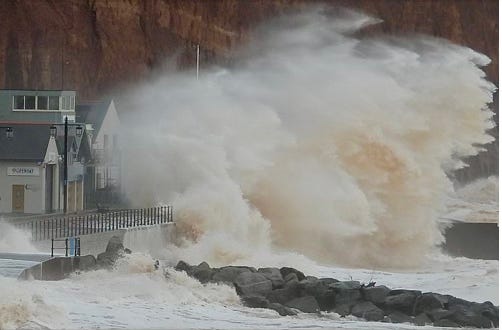
Even the gulls couldn’t settle on the water.
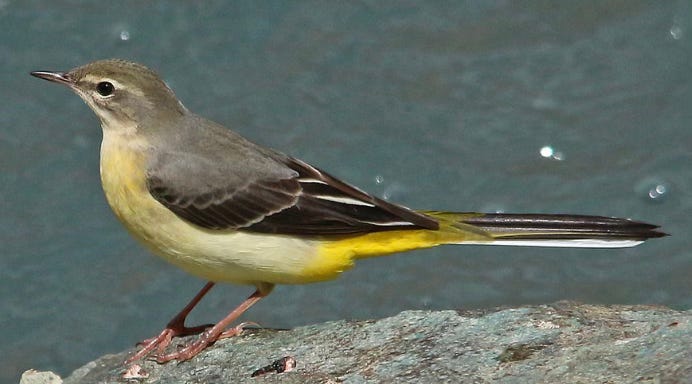
Last weekend’s Big Garden Birdwatch was, to use the obvious cliché, a washout. In my hour of watching I spotted only a robin, a blackbird and a magpie, and they were wetly miserable. The usual birds were nowhere to be seen—the wren, dunnock, blue and great tits, no goldfinch or greenfinch, not even the woodpigeons braved the sluicing rain. I added just one new bird to my 2026 spotted list this week—a grey wagtail. A pretty little thing, grey on top and a yellowy buff underneath, flicking its tail, exploring the roof tiles on next door’s garage. They have this sweet habit of foraging in one place, then flying up and away a few yards and then running back to the place they were foraging at. We see their pied cousins a lot, often in pairs, but the grey is more usually down by the river than around our gardens. I guess the water got too high for him to forage in the usual places.
As mentioned last week I have been reading Ian Collins’ biography of Ronald Blythe, ‘Blythe Spirit’. Ronald Blythe (1922–2023) was a writer devoted to attention: to people, to landscape, to the passing of time, and to the most important thing in his life—his writing. He is best known for Akenfield (1969), the portrait of an English village, built from many voices and using lived experience as well as invention. Leaving school at fourteen, Blythe educated himself through reading, libraries, long walks, the cultivation of cultured friends, and conversation. When asked about his background he would speak vaguely of coming from ‘an old farming family’ and rarely discussed his personal life. He settled in East Anglia, where the rhythms of rural life and the Church of England shaped both his work and his thinking. Across essays, memoir, criticism and nature writing, he wrote with clarity, humility and moral seriousness, recording the old and changing ways of life without sentimentality.
Blythe Spirit is an interesting book, both in content and in structure. This is no linear, chronological biography; rather each short chapter concentrates on a single theme, and relies heavily on Blythe’s own words from conversations over the later years of his life. Drawing on years of friendship, letters and close observation, Collins shows us a man both reticent and intense: offering us an intimate and revealing insight into ‘Ronnie’, carefully and affectionately unwrapping those areas of his life that Blythe rarely shared with others—the impoverished hardship of his childhood and his sexuality. Far from being from an old farming family Blythe was born into poverty, the eldest of six children born to a nurse and a Suffolk labourer, sharing a room with his siblings and a bed with a younger brother until he left home. He tells of the ignominy of cousins having to bring straw to stuff the family mattresses as the Blythe’s were too poor to provide their own. Of having nothing. Of walking everywhere, miles and miles to anywhere he needed to go. He left school at 14 and began his self-education through books, libraries and better educated friends. He discarded his Suffolk accent and developed the patrician tones that made him such a popular and affecting Lay Preacher in the churches of his parish. His famed farmhouse home, ‘Bottengoms’ was left to him by artist friends John and Christina Nash, he mixed with cultural luminaries such as E M Forster, Ben Britten and Peter Pears, Sir Cedric Morris and his partner Arthur Lett-Haines, Patricia Highsmith, Imogen Holst, Roger Deakin and Richard Mabey. The book is full of wonderful, gossipy anecdotes about this circle of friends and how he was influenced and learned from them—always watching, listening, paying attention. His development as a writer, countryman, essayist, everything he became, is the weft through the stabilising warp of these relationships.
Collins is honest without being salacious about Ronnie’s private life, but the extent of his casual sexual relationships may be something of a surprise to some readers. In his youth there is sex in haystacks and in fields, ‘the best sex ever’ with other young soldiers when he was conscripted in war time, a beautiful, blonde civil servant, and then regular assignations with a local indolent 21-stone rector. As he moved in more rarefied circles his lovers (if the word can be applied to these casual sexual encounters) included the writer James Hamilton-Paterson, the artist Arthur Lett-Haines, an un-named but physically ‘perfect’ Bajun poet, even a dalliance with crime-writer and lesbian Highsmith. In later life, when he lived alone at Bottengoms he managed to take ‘opportunities’ with a temporary postman. But none of this ever got in the way of his writing. He was matter-of-fact about sex, an enjoyable necessity but never a distraction from his main purpose.
As I said earlier, it’s a fascinating book. Because Collins relies so much on quotes from conversations with Blythe, I sometimes found the narrative a little disjointed. The mixed use of first names and surnames meant I was occasionally confused about who was talking about whom. I learned quite a bit about E M Forster, and a lot about Britten and Pears and Imogen Holst during Blythe’s time helping with communications for the Aldeburgh Festival. We get a good look at Cedric Morris and Lett, the Nashes and his great friend poet James Turner. The biography is candid, amusing, enlightening, surprising. Blythe’s life emerges like a moth from a cocoon, but I felt a little sadness that the Blythe whose writing I enjoy so much, the wise and rurally-rooted champion of passing times, the sage and erudite wordsmith, the literary country and church man, came into sharper focus as a truly ‘self-made’ man, a self-invented man. A conscientiously air-brushed start in life, a discarded ‘peasant’ accent, a lively but hidden private life; it felt like the soft inside of a carefully constructed shell. Did it matter? Not in the end, although the words of artist Maggi Hambling resonated with me, quoted from a discussion with Ian Collins about the biography:
Reflecting on their enduring friendship – with mutual affection, but with neither party being in the other’s inner circle – she says: ‘I never saw Ronnie with anyone. I always imagined he was gay, but without any evidence. He wasn’t physical in the sense of giving you a great big hug or even pecking a kiss. He was reserved, watchful.’ Surprised when enlightened, Maggi especially loves the idea that the formally dressed figure was a lifelong naturist. And she’s astonished by the depths of his early poverty, the lack of formal schooling and the jettisoned peasant burr. Then, after musing in a long silence, in which new pieces are slotting into an old mental image, she says: ‘So he was a complete invention, like Noël Coward. How amazing.’
Blythe Spirit by Ian Collins. pp. 219-20
How amazing indeed. To live for a hundred years and be so known and so unknown. I admire that, Blythe was exactly who he wanted to be, and he was happy with that. I admire him for it. I shall still revisit the old volumes of Word from Wormingford on my shelves, Akenfield and The Yeoman’s House, and The Time By The Sea, and I shall still seek out his other books with a heightened interest from knowing a little more about the man. I commend it to you, it’s an instructive read about so many people and places, and relationships, and in my view, Blythe’s considerable legacy is strengthened by it.
And that’s where I finish for this week. Take care and I’ll write soon. x.
P.S. There is a transcript here of a terrific conversation between Ian Collins and John Goodridge about the writing of the biography.
I just adore his writing. And I admire him for not allowing himself to be fully known, while also being completely unashamed! Very glad he was happy and enjoying himself. Aren’t people interesting?!
Interesting about Roland Blythe. His "The Age of Illusion", about the period between the two world wars in Britain, is one of my absolute favourite books. Hugely insightful and lucid about key aspects of British life and society. The chapter on the Rector of Stiffkey is hilarious, and those on the Abdication and the downfall of Chamberlain are masterpieces. Do seek it out if you haven't read it. I think it's far superior to his other, better-known books.
Unremittingly wet here, with boiling, churning, murky seas and overflowing rivers. But there are snowdrops.