
Hot enough for June
Indeed a little too hot for this June

Hallo everyone, and a happy Saturday to you all. I hope you dealt with the super-hot weather in the best way for you, and I hope you are looking forward to something a little cooler over the weekend. Hasn’t it been scorchio?! For two days we confined ourselves to the house (neither of us do boiling very well) and only ventured out when it got a little cooler from Wednesday. As it’s half-term week and hot weather, the town is packed with visitors and the beach is beyond packed. Looking at the mounds of white flesh on display I can’t help worrying about sufficient sun-block, cold drinks, and small heads without hats. Ah me, the Great British public at play. Martin Parr would’ve had a field day. Pink, glowing shoulders everywhere, no shoes on the shingle beach so lots of ‘ooh’-ing and ‘ouch’-ing on the way to the sea, and one man who had carved out a piece of beach just for himself and looked as though he planned to repel all boarders.


There is nothing more fun than watching people (surreptitiously, of course) on the beach. AND people still do that mad wriggling thing of trying to get into or out of a swimsuit under a bath towel while husband and kids ignore the staggering about and balancing on one leg. Very little changes at a small, traditional seaside resort. Melting ice cream, sandy sandwiches, thieving seagulls, paddling with mom or dad, kicking a beach ball around, not enough water, and too far to the toilets. Ah, memories of childhood.
My childhood holidays were spent in east Sussex, staying with a maternal aunt in Battle. We would drive down from the West Midlands, rather thrillingly starting out at 3.30am, and six of us packed into an old Morris Oxford (8170 RE, the registration plate is clear in my memory from sixty five years ago, even though I have to keep a photo of my current car to remember it’s registration for parking…), mom and dad, me and my sister and brother, and my grandmother, plus our luggage and food for the six hour journey. It took six hours because way back then in the early 1960s my dad wouldn’t drive on the motorway, so we wound our way via the scenic route from South Staffordshire to East Sussex. I would be travel sick within the first six miles and every six or so miles after and everyone would hate me. My Dad and my sister would place bets on how many times I was sick between home and destination. One time she won half a crown and shared it with me because ‘I wouldn’t have won it without you’. Ah, sisterhood.
I’m going to stop writing for a minute and show you this, which has just appeared and is glowing palely (rather like me on the journey to Battle) but rather beautifully through the sitting room window. Not quite full, but very nearly.
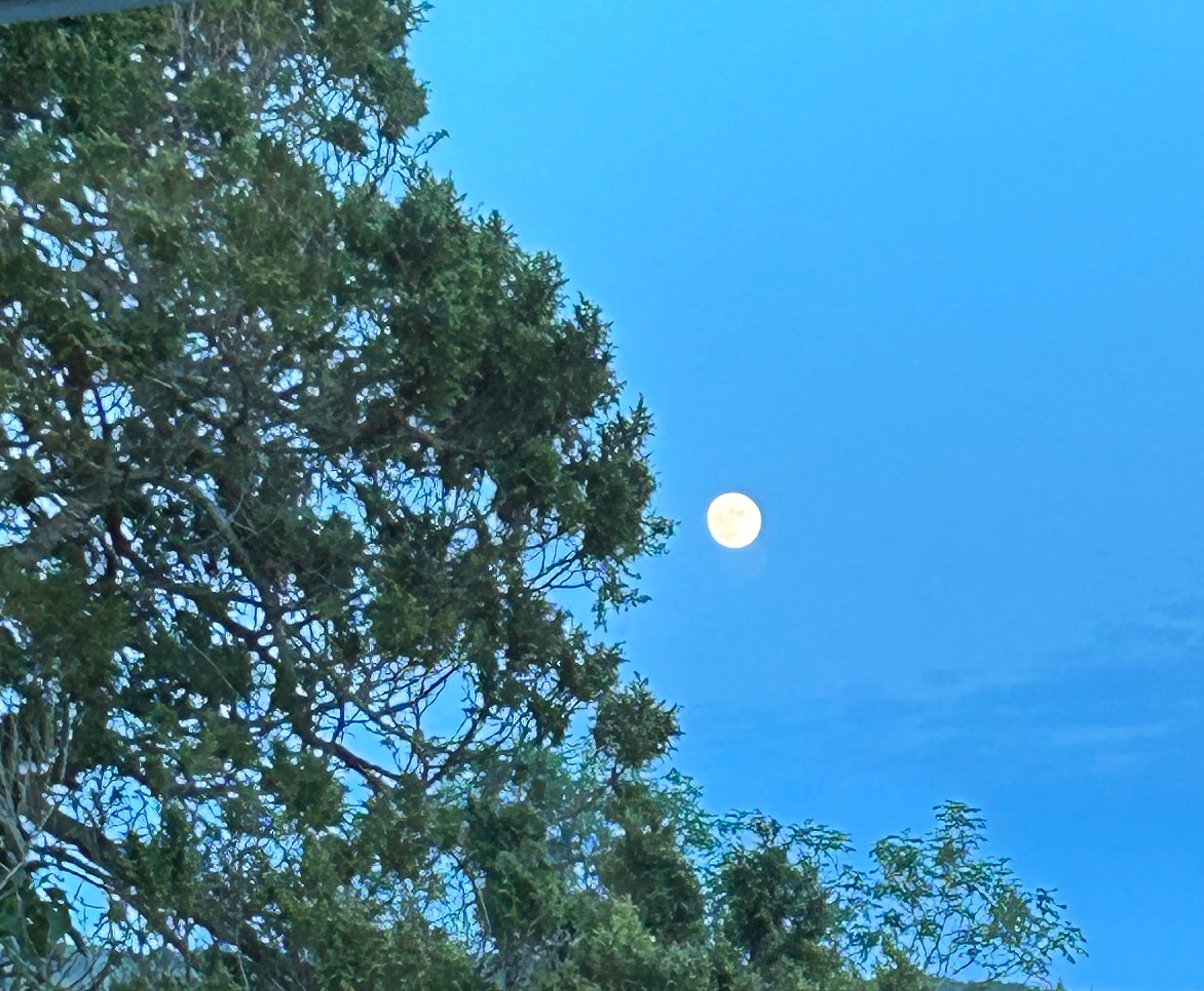
It will be full tomorrow May 31st (I’m writing on Saturday) and will be a Blue moon, the second full moon in May (the last one was on May 1st). Two full moons can happen in a single month because the lunar cycle (29.5 days) is shorter than our calendar months (30 or 31 days). So, the moon cycle has completed again before the month ends. It only happens every two to three years so is not a common occurrence, hence (probably) the phrase ‘once in a Blue moon’, meaning not very often. If you’re in the same part of the world as me, pop out to look at it if you can. It will also be at its apogée meaning the furthest away from the earth so will appear smaller and not so bright as usual. Sometimes called a Micromoon. So a Blue micromoon.
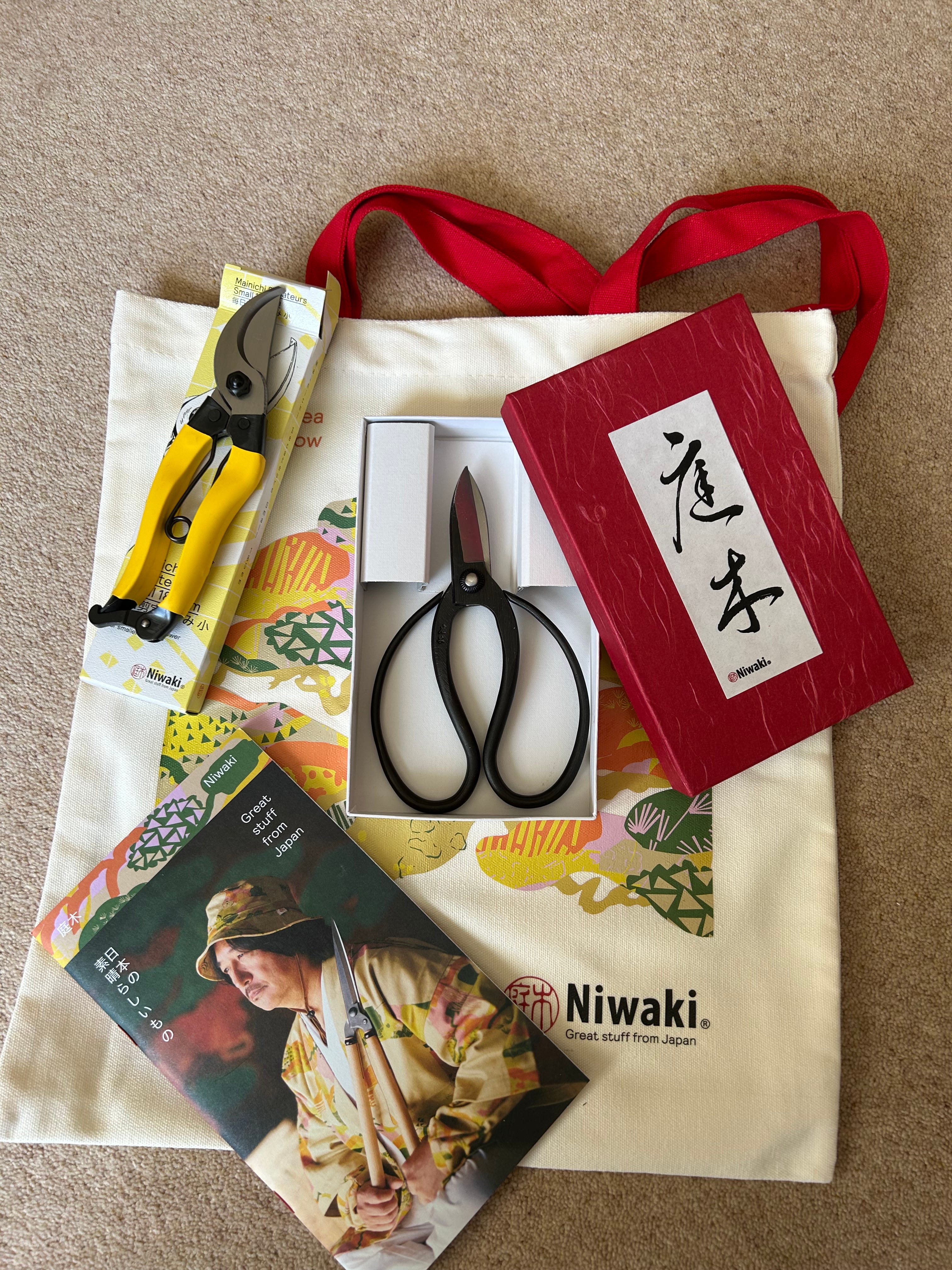
It’s been too hot to have been doing anything in the garden except sit, read and drink tea, but thanks to Amy from Craft and Thrift substack I have discovered Niwaki garden tools. I ordered a pair of secateurs for small hands and also some garden scissors and both arrived today, beautifully packaged with a catalogue (darlings, their garden clothes! Far beyond my budget but marvellous) and a perfectly sweet tote bag. They would make heavenly presents for a keen gardener. The scissors especially are a wonder to behold and a perfect weight for dead-heading, very light pruning etc. Just the sort of snippy snipping that I love doing around the garden. I am smitten and shall be saving up to replace my other small garden tools when they need it. Look:
Also arrived this week–two books from laura thompson : ‘Heiresses’ and ‘Au revoir now darlint: The letters of Edith Thompson’. Both of them are going to the top of my reading pile, I am relishing reading them both. Thank you so much to Laura who has cheered me no end after a difficult couple of weeks. Already on my bedtime reading table is Melissa Harrison’s latest novel The Given World. The reviews are so brilliant I am slightly scared to open it because I don’t want it to be over too quickly. I am planning a slow read and probably a re-read to make sure I get the most out of it. Reading new stuff is always so exciting.
Books finished this week were The Public Image by Muriel Spark and Dear Mrs Bird by AJ Pearce.
Muriel Spark’s The Public Image feels surprisingly contemporary. Published in 1968, it is ostensibly about celebrity culture in postwar Rome, but it reads like a tale of our social-media age. Its protagonist, Annabel Christopher, is a British actress whose fame depends less on artistic talent than on the careful cultivation of a public persona. She is known and adored (thanks to her publicity machine) as a wholesome, beautiful screen star, the embodiment of grace and good nature. Behind the scenes, however, her talent is small, her appearance enhanced, and her marriage to Frederick, a failed actor, is unhappy and increasingly toxic. Frederick resents both Annabel’s success and the falseness of the image on which it rests. As his bitterness deepens, he becomes determined to expose what he sees as the emptiness at the centre of her celebrity. The plot turns on the collision between private misery and public narrative. After a shocking tragedy, Annabel finds herself confronted with a choice: grieve (or not) honestly or preserve the image that has made her famous. Around her swarm journalists, agents and opportunists, all eager to shape her story for their own purposes. Spark unfolds the scandal with characteristic coolness, showing how quickly a human life can be transformed into a consumable spectacle. As ever, Spark refuses to sentimentalise anyone involved. Annabel is neither villain nor victim; Frederick is unpleasant but not entirely wrong. Even the media figures are portrayed less as monsters than as participants in a system that rewards performance above authenticity. The prose is lean, elegant and often very funny; in little more than 150 pages she produces a razor-sharp satire of fame, image-making and the uneasy relationship between who we are and who the world wants us to be. Nearly sixty years on, The Public Image feels like a warning that arrived early. I think this might be one of my favourite Spark novels.
I picked up Dear Mrs Bird because I follow and enjoy AJ Pearce’s substack Notes of Cheer. It is the first novel of a quartet following the fortunes of Emmy Lake, a young woman of optimism and considerable charm. Set in London during the Blitz, it combines wartime hardship with humour, friendship and romance, and the story is anchored by a protagonist whose positive nature feels hard-won rather than naïve, avoiding sentimentality or nostalgia. Emmeline Lake dreams of becoming a war correspondent but instead, after answering what she believes is an advertisement for a job with a newspaper, she finds herself working for Woman’s Friend magazine under the formidable Mrs Bird, an agony aunt whose list of forbidden topics is comically extensive. No letters concerning relationships (no sex, affairs, divorce or other ‘unpleasantness’), no loneliness, grief, financial troubles or anything remotely lowering are to be acknowledged. Her advice is of the ‘brace up and crack on’ sort. Faced with sifting through the often heartbreaking letters that arrive from readers, Emmy quietly begins responding to some of them herself. The plot unfolds against the backdrop of wartime London, where air raids and uncertainty are part of everyday life. Pearce captures both danger and the resilience of the period, but for me, the novel’s real strength lies in its attention to ordinary acts of kindness. Emmy’s friendship with Bunty, her determination to help strangers, and her stubborn belief that people deserve compassion are at the heart of the book. It’s also a very funny novel (I was laughing out loud by the second page), there are moments of terror and pathos (both well observed and without sentimentality) and an engaging cast of characters who I hope will be reappearing in the rest of the books. I really liked the way Pearce shows how laughter so often coexists with fear, and how small gestures acquire enormous significance during difficult times. Dear Mrs Bird is something rather lovely: an affectionate and engaging story about decency and friendship, with moments of history (the bombing of the Café de Paris is particularly well done) and plenty of sharp humour about every day life in 1940s wartime. I thoroughly enjoyed it and am looking forward to reading the remaining three in the quartet.
And that, my dears, is that for this week. I hope you had as much fun reading as I had writing, and I hope you will hit the little heart to say so. For those who may wish to know, A is doing okay and pottering about. You take care of yourselves, and I will write again soon.

Thank you June for the kind mention. You made me long to return to that Spark novel, haven't read it in ages.
I love the memory of the car number plate. Like old phone numbers, I could still (theoretically) ring both my grandmothers...
I’ve recently read my way through all four Emmy Lake books and loved them. The right mix of humour and sadness. They feel very authentic and well researched too. I have borrowed a copy of Dear Mrs Bird for my home library client, aged 101, and I’ll be interested in her verdict.