

A bit random this week

Hello friends, and welcome to this week’s post. There has been a definite change in the weather, mostly it’s not raining constantly, but there has been a bit of sunshine too. Not much, it has to be said, but enough to raise the spirits a little. And goodness they need raising. No politics on here, but blimey, it all feels like a horrible mess. All the more reason for finding the joy in the weather, in the seasons, in the flora and fauna of all and every kind, the changing light levels and the increasing warmth in the sun (when it shows itself). And reading and books, and eating something other than winter-warming casseroles, and looking in the wardrobe every morning and wondering if this jumper is too heavy now, or could I leave off a layer? An ordinary life, and I thank heaven for it. This may be a small and over-crowded island but my part of it is lush and green (all that rain), or soon will be. The blackthorn in the hedgerows has bright green new leaves appearing, mosses are vibrant, the smell of wild garlic is pungent under the trees and the strappy leaves of bluebells are clumping up. The daffodils on Peak Hill are at their golden best. In the garden the roses have new shoots, primroses are shining out—they’ve self-seeded in the lawn and I love it—and the little blue pyramids of muscari are everywhere. Tulips are just showing in the pots on the front step, and this week I shall deadhead the hydrangeas ready for this year’s flowers. The garden birds are calling in the mornings and huge queen bumblebees are bumbling around the windows. It will soon be all go in the garden. There is a tiny blot on this landscape—The Shed. It’s a horrendous mess of a place for everything (quite literally) and nothing in its place. We know it has to be cleared out and organised for the new season, but oh, it’s the worst job. The cobwebs, the massive spiders, ugh. I can’t bear to think about it. Pretty much the same applies to The Greenhouse. In the winter it takes on the guise of temporary storeroom when we can’t be bothered to go as far as the shed, and has the same issues—cobwebs and spiders, dead flies, etc. Last week in the search for some gardening gloves I picked up a pair off the staging and a huge garden spider dropped out. The screams could be heard in Exeter. A had to come and investigate each finger before I would put them on, and he’s not very keen on them either—spiders, that is, not gardening gloves. This weekend we will be poring over catalogues for summer bulbs and thinking about new perennials. It definitely lifts the spirits and I’d rather be oiling the wheelbarrow than thinking the world is going to hell in a handcart.


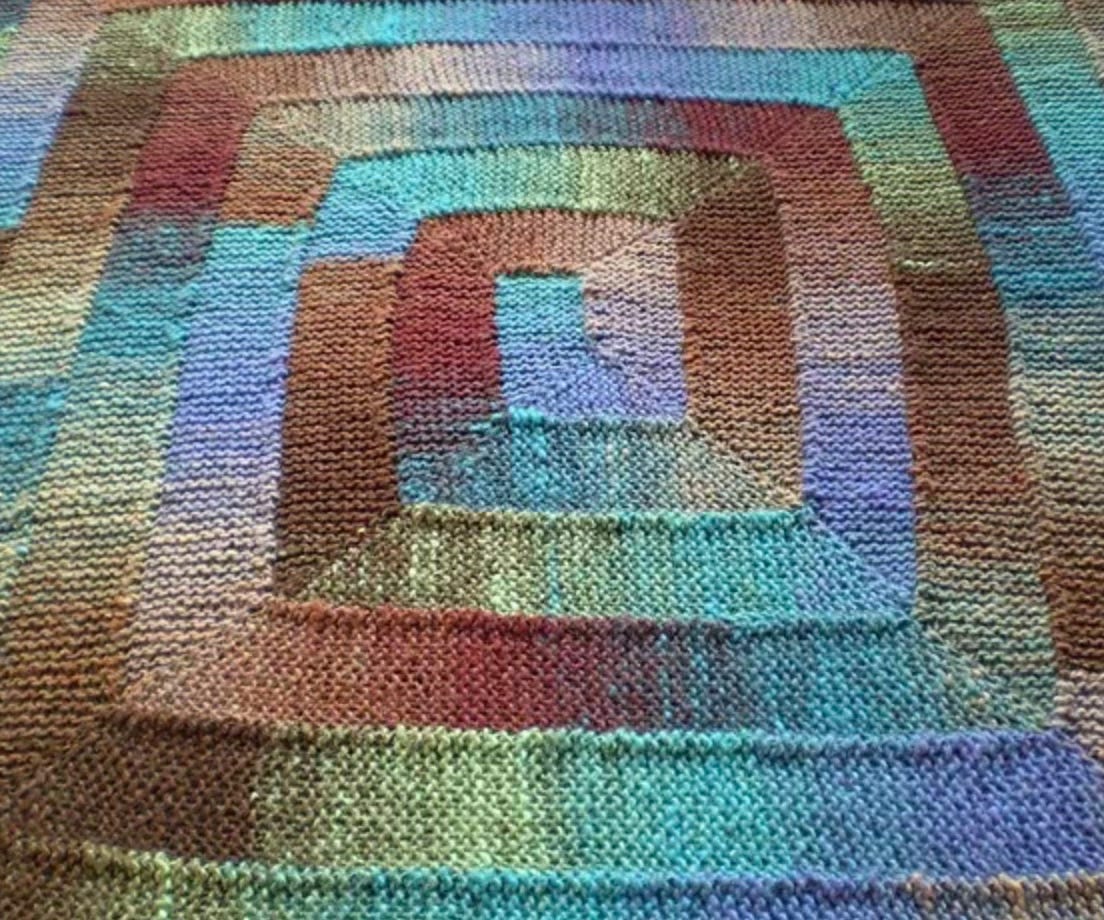
The lovely colour-work waistcoat I showed you last week, or was it the week before?, anyway, the green waistcoat with the yellow flowers, has had to be ripped back. When I had joined the shoulder seams I thought I’d better try it on before I cut the front steek. Too tight. Much too tight. And I’d swatched and knit one size up from normal for ease, and everything. So, in a fit of pique I ripped the whole lot back, rewound the yarn and have put it away for later in the year before I try again. Not having much luck with garments—the massive cardigan and now the tiny waistcoat. Grrr. I have to have some knitting on the go so I’ve started a 10 stitch blanket with the not very nice yarn that was gifted to me last week. I thought that even in its ghastliness it might make a blanket for the garden seats. So, to make it more interesting I am knitting it as a temperature blanket (that’s with colours organised as to the noonday temperature everyday.) Obviously I have to catch up to March a bit but it’s working out okay. The colours in the gifted wool are not brilliant but there’s enough to make 3 degree gradations. To be honest it looks pretty bad, but I shall carry on regardless, as a blanket that will only be for outside use it doesn’t have to be a work of art. And it won’t be. Also, because the yarn is quite thick, somewhere around aran/heavy worsted weight, that ridge that you get on 10 stitch blankets is very prominent and horrible. But I DON”T CARE. In the spirit of ‘don’t look a gift horse in the mouth’ it WILL be a garden blanket. I won’t photograph it out of a sense of shame. If you are wondering how I know the noon-day temperatures from the beginning of the year, well, shoot me now, I asked Chatgpt. And it gave me a nice easy table of every day for the two months. So, it has its uses. If you want to knit your own 10 stitch blanket, the pattern is by Frankie Brown, it is free and available on Ravelry here. This is what a decent one looks like.
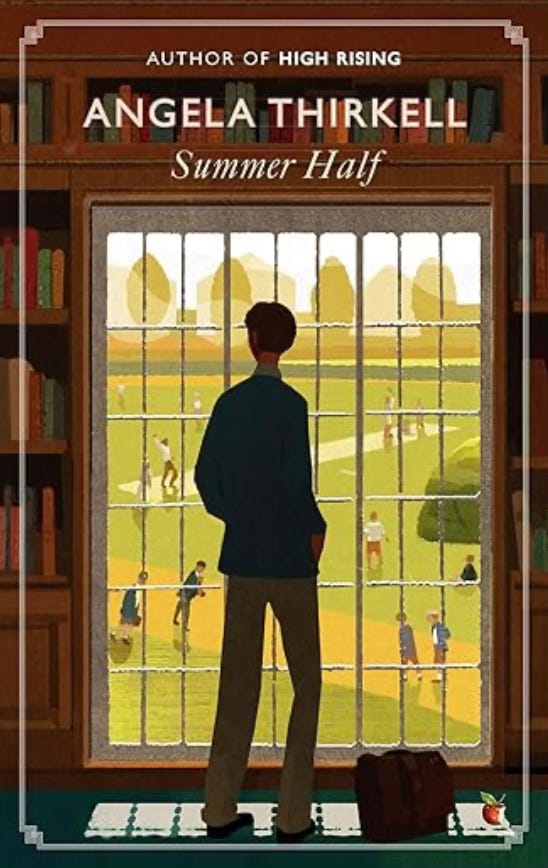
I’m back to lighter reading this week. Angela Thirkell’s Summer Half was exactly what I expected; bright and breezy, temporarily star-crossed would-be lovers, picnics and punting on the river, a sideways look at all kinds of relationships: father and son, mothers and children, platonic and romantic friendships. It’s a delight. Here’s a quick look at the main characters:
Colin Keith arrives at Southbridge School as a temporary Master with the noble but slightly misguided idea that he ought to earn his own living before becoming a barrister. Teaching classics to a room full of intelligent and faintly predatory boys turns out to be rather more alarming than he had imagined. Colin is clever, sensitive, and just self-aware enough to realise he may have made a mistake.
Every boys school needs at least one person who appears quietly in control, and at Southbridge that is Everard Carter. In his thirties and far more experienced than the younger masters, he manages boys, crises, and colleagues with calm efficiency. Carter understands that school life runs on tact, routine, occasional firmness, and a love for the job and the well-being of the boys. Beneath this steady competence is a thoughtful man who has been quietly waiting for the right person to love.
That person is not, however, Rose Birkett, the headmaster’s daughter. Rose is a terrific comedic invention of Thirkell’s and sweeps through the story on a wave of astounding empty-headedness. Beautiful (of course), impulsive, and magnificently silly, she has an alarming propensity for serial romantic engagements. At the beginning of the novel her latest fiancé is the classics master Philip Winter—a situation that fills the entire school with dread. Rose loves fun, jolly young men, admiration, romantic scenes, and emotional attention, though she has very little idea what any of these things mean in practice. Watching the adults attempting to manage the consequences of her nit-wittery is one of Thirkell’s most delicious jokes. Poor Philip Winter is completely undone by Rose; he is in a state of emotional agitation that the rest of the staff observe with deep unease. He argues, broods, is wildly jealous and far too serious for his own good.
Of the younger cast, Lydia, Colin’s younger sister, is a glorious force of nature. In her mid-teens, she is boisterous, loud and enthusiastic about everything, and expresses her opinions at a volume that explodes off the pages. Lydia has absolutely no instinct for social caution, which allows her to say the things everyone else is politely avoiding. She brings energy, chaos, and unexpected honesty wherever she appears, and the novel is livelier for her presence. Her older sister Kate, is quiet, unassuming, and helpful, but doesn’t go unnoticed. In addition, we are reintroduced to an older (and less annoying)Tony Morland, first met in Thirkell’s High Rising. He and his friends Swan and Hacker (with pet chameleon) act as something of a Greek chorus to the adult drama. Tony is bright, articulate, and a bit scary in intelligence for one so young, and he has an unnerving habit of speaking to all adults, including the schoolmasters, as though he were their contemporary. The boys watch the romantic entanglements of the staff with fascinated amusement while pursuing their own serious concerns —cricket matches, friendships, rivalries, cleaning out the frog pond and testing authority without quite getting caught.
Together with parents, adult friends, and village neighbours, these characters create the gentle machinery of Summer Half: a term full of boys who think they are grown up, masters who are discovering that they may not be, and a Barsetshire summer in which love affairs, cricket matches, and Latin lessons all seem — for the moment — equally important. Loved it and can’t wait to get hold of a couple more in Thirkell’s Barsetshire series.
I also read most of Marble Hall Murders, Anthony Horowitz’s latest Atticus Pünt/Susan Ryeland offering. I admire Horowitz immensely but this trio of books have left me a bit cold. At this point I should say that I really enjoyed the TV adaptations with Lesley Manville (who is a favourite actress) and found them much more digestible than the novels themselves. The ‘book-in-a-book’ conceit annoys me and makes heavy weather of the reading for me. I enjoyed and was impressed by the first one, Magpie Murders, less enamoured of Moonflower Murders and this last one never really took off at all for me. Right at the beginning there is a family tree, and one look at it made me stop and think, surely not, he’s surely not going to do the clichéd thing here, is he? But reader, he did. Which means I pretty much knew who the murderer was going to be from the start. I confess to skim-reading it. Hey ho, win some, lose some.

Before I go I must tell you about a TV programme I’ve just watched: L. S Lowry—The Unheard Tapes. It makes use of a series of tape recordings made by a young woman in 1972, Angela Barratt. She was a fan, and spent time with the artist, asking a range of interesting and telling questions. The BBC have dramatised the interviews, with Ian McKellen lip-synching to Lowry’s voice from the tapes. It’s remarkable and a tour de force by McKellen who is lip perfect with Lowry’s voice. Do watch if you can. I’ve also been catching up with the new adaptation of Lord of the Flies, which is challenging and fascinating in equal measure. I remember reading it at school, but I don’t remember finding it this disturbing. Their behaviour seems all too possible now. Inevitable even. To see these boys alive and real is very, very unsettling.
My mother died ten years ago this year. She would’ve been 100 last week. I wrote about her here. I didn’t like her very much, but I can honour her memory.

And that’s it for this week. Take care and I’ll write soon. x

I’m so glad you enjoyed Summer Half. Thirkell is a bit of an obsession of mine. If you continue to read her books in order you will enjoy the one where Rose does get married and also the one where she Comes to the Rescue!
You have no idea how encouraged I am to know that I am not the only one who has to rip back knitting projects that are the wrong size. I am on my third attempt at a pullover: first try( measured everything carefully, swatched, the whole caboodle) way, way too tight. Second attempt, ran out of yarn just before the cuff of the second sleeve, thought I should check before buying another skein- I was drowning in it! Now busy with an in-between size with my teeth gritted, and have told my husband (who doesn’t have much interest in knitting) several times that I am going to abandon the whole project if this one doesn’t fit and knit my baby granddaughter a couple of hats for winter instead. She doesn’t have much hair, so she’ll be needing to keep her head warm.